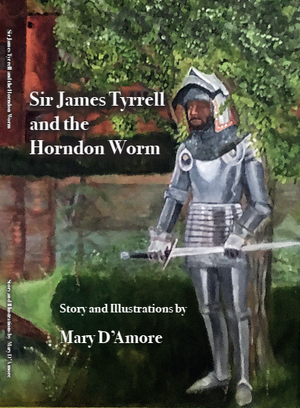
Sir James Tyrrell and the Horndon Worm
(Due for Publication 2026)
Dragons and knights – Yes, please!
This book retells a 14th-century English legend in which Sir James Tyrrell, a knight serving Edward III, is said to have slain a fearsome creature known as the Horndon Worm. In medieval England, the word worm referred not to an earthworm, but to a large serpent or dragon-like beast believed to threaten people and livestock.
Sir James Tyrrell was a real historical figure, and families bearing his name appear in 14th-century records in southeastern England. Like many medieval legends, the story of the Horndon Worm is closely tied to a specific place and a real noble household, suggesting it grew from local memory rather than pure invention.
The legend is also shaped by medieval encounters with the unknown natural world. Historical accounts describe exotic animals—such as crocodiles and large reptiles—arriving in Europe through Mediterranean and North African trade. These animals were sometimes transported by merchant ships and, when they escaped or were discovered far from their native lands, were commonly described as dragons.
This story brings together those two strands: a real knight and a creature that medieval people could reasonably have believed to be a dragon. Rather than treating dragons as fantasy, the book explores how fear, limited scientific knowledge, and unfamiliar animals helped transform real events into lasting legends.
I researched this story after I discovered that Sir James Tyrrell may appear in my own family’s historical record many generations back.

I include this lineage (click on book pages above) not as a claim of ownership, of course, but as an invitation to inquiry (and as a bit of fun for my grandsons whose grandfather’s surname was Tyrrell). When records thin and certainty disappears, stories often survive in altered forms through poetry, legend, and imagination. This book, while planting only a seed for a child’s future learning “connections,” explores how people in the past explained what they couldn’t understand, and how those explanations became stories that still echo today.

The present building is the second – possibly the third church to stand on the site. The parish contained two manors – Heron on the north side, long associated with the Tyrell family, and Abbots (close to the church) on the south side, held for centuries by the monks of Waltham Abbey.
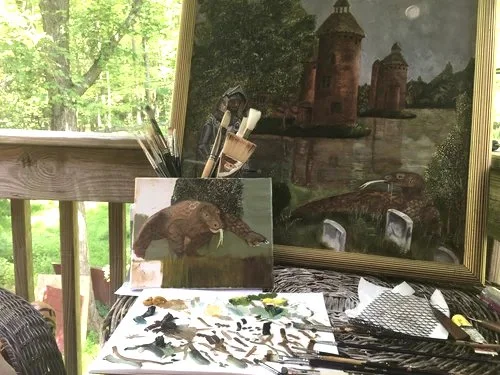
Painting Heron Hall and the “worm.”
© 2026 Mary D’Amore, All Rights Reserved