The Legend of Prince Henry Sinclair
(Due for Publication 2027)
Henry Sinclair was born in 1346 and lived at a time when the oceans beyond Europe were still largely unknown to most people. For early explorers, sailing meant danger, uncertainty, and the hope of discovering new lands, new trade, and new sources of wealth.
Long before Columbus, Norsemen had already reached parts of North America, and medieval sailors from Scotland, Venice, and Genoa traveled widely across the Atlantic world. Some historians believe that Henry Sinclair may have been among those early explorers.
According to legend, Sinclair sailed west with the Zeno brothers, members of a Venetian family associated with a mysterious medieval map and travel account. These stories suggest that their voyage may have reached lands far across the Atlantic - even North America.
Medieval maps are often symbolic rather than precise, and written records from this period are fragmentary. Still, the idea that sailors explored farther than official history once acknowledged continues to intrigue historians.
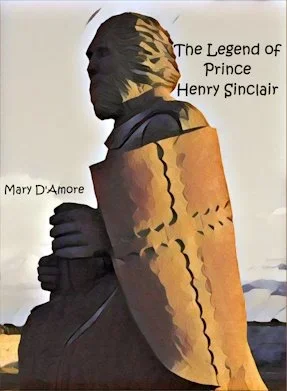
Henry Sinclair Statue
Noss Head Lighthouse, Caithness, Scotland
This statue depicts Henry Sinclair (born 1346), the Scottish noble associated with legends of early Atlantic exploration. Positioned overlooking the sea, the figure gazes outward, symbolizing leadership, navigation, and the enduring human impulse to explore beyond the known world.
This book invites readers to stand at the edge of the medieval world, to consider what people believed, what they dared to attempt, and how legends grow.

I include this lineage (click on book pages above) not as a claim of ownership, of course, but as an invitation to inquiry (and as a bit of fun for my grandsons). When records thin and certainty disappears, stories often survive in altered forms through poetry, legend, and imagination. This book, while planting only a seed for a child’s future learning “connections,” explores how people try to explain what seems impossible, such as corn cobs and aloe plants carved in the stone of the Sinclairs’ Rosslyn Chapel shown below, when none had been known in Scotland or Europe at that point in time, and how those explanations became stories that are still told today.

© 2026 Mary D’Amore, All Rights Reserved